Picking carts

Set up picking carts with numbered boxes – without an active cart with boxes no picklist can be created.

A picking cart (Kommissionierwagen) is the physical cart on which a picklist is worked through. Each cart has numbered boxes. When a picklist is created, every order (or, with rolling picking, every article) is assigned to a box. At the packing station the box number is scanned later to pack the order.

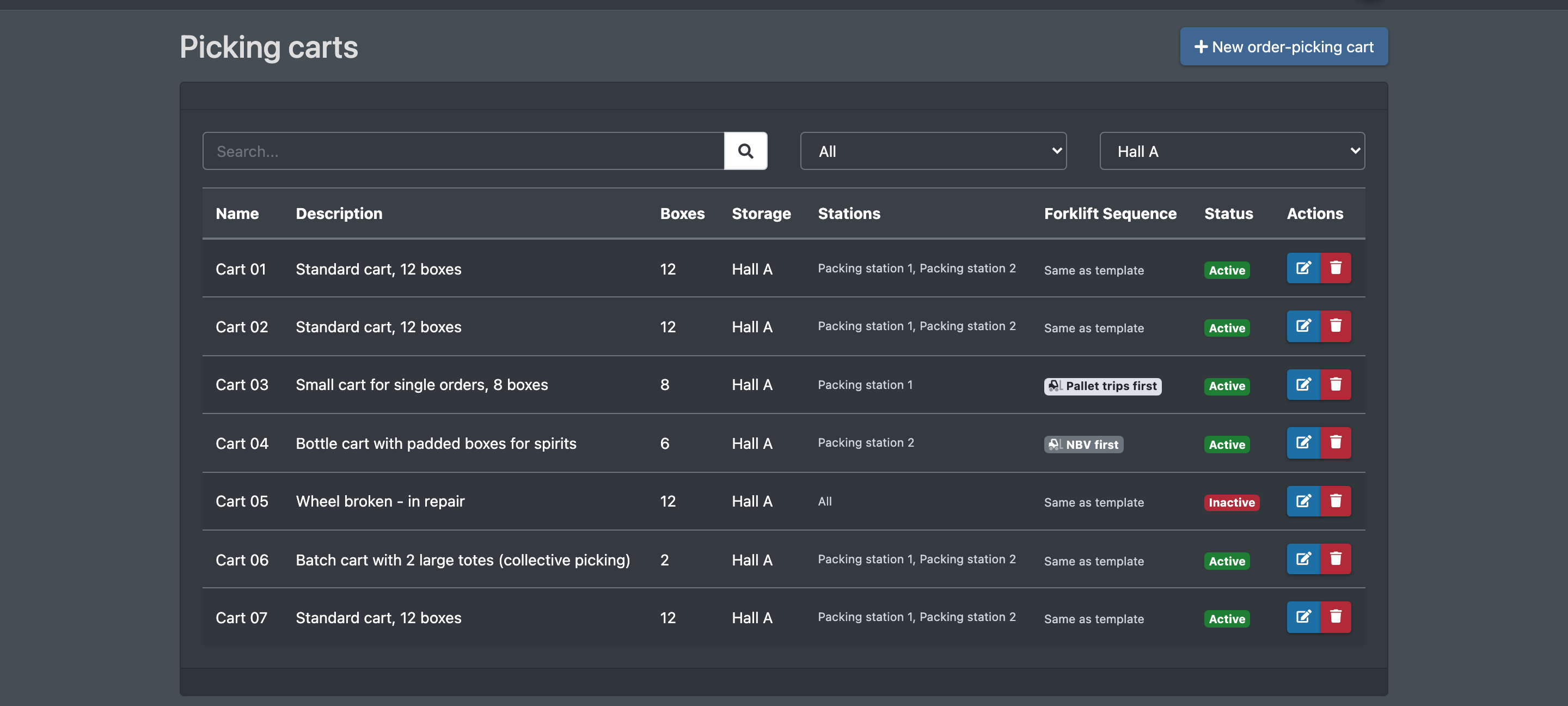
Screenshot: Picking carts list with the columns Name, Description, Boxes, Warehouse, Stations, Forklift order and Status

Before you start

  • At least one warehouse exists. The Warehouse field only appears if you have more than one warehouse.
  • Your user needs the permissions WMS and Picking carts (Kommisionerwagen) – ask your administrator.
  • Optional: packing tables, if a cart may only be packed at certain packing stations – see Packing tables.

Step by step

  1. Open WMS › Settings › Picking carts (WMS › Einstellungen › Kommisionerwagen).
  2. Click New picking cart (Neuer Kommissionierwagen).
  3. Enter a Name (Name) and, if you like, a Description (Beschreibung). The name is scanned or typed in during picking, so choose a unique name that can be printed as a barcode.
  4. Create the Boxes (Boxen) – two ways:
    • Range: fill in From box number (Von Box-Nummer) and To box number (Bis Box-Nummer), e.g. 1 to 12. All boxes in between are created automatically.
    • Individually: click Add box (Box hinzufügen) and enter single box numbers.
  5. If you have several warehouses, choose the Warehouse (Lager).
  6. Optional: choose the Packing stations (Packstationen).
  7. Optional: set the Order of forklift tasks (Reihenfolge der Stapler-Aufgaben).
  8. Leave the Status on Active (Aktiv) and click Save (Speichern). You see "Picking cart was saved" (Kommissionierwagen wurde gespeichert).
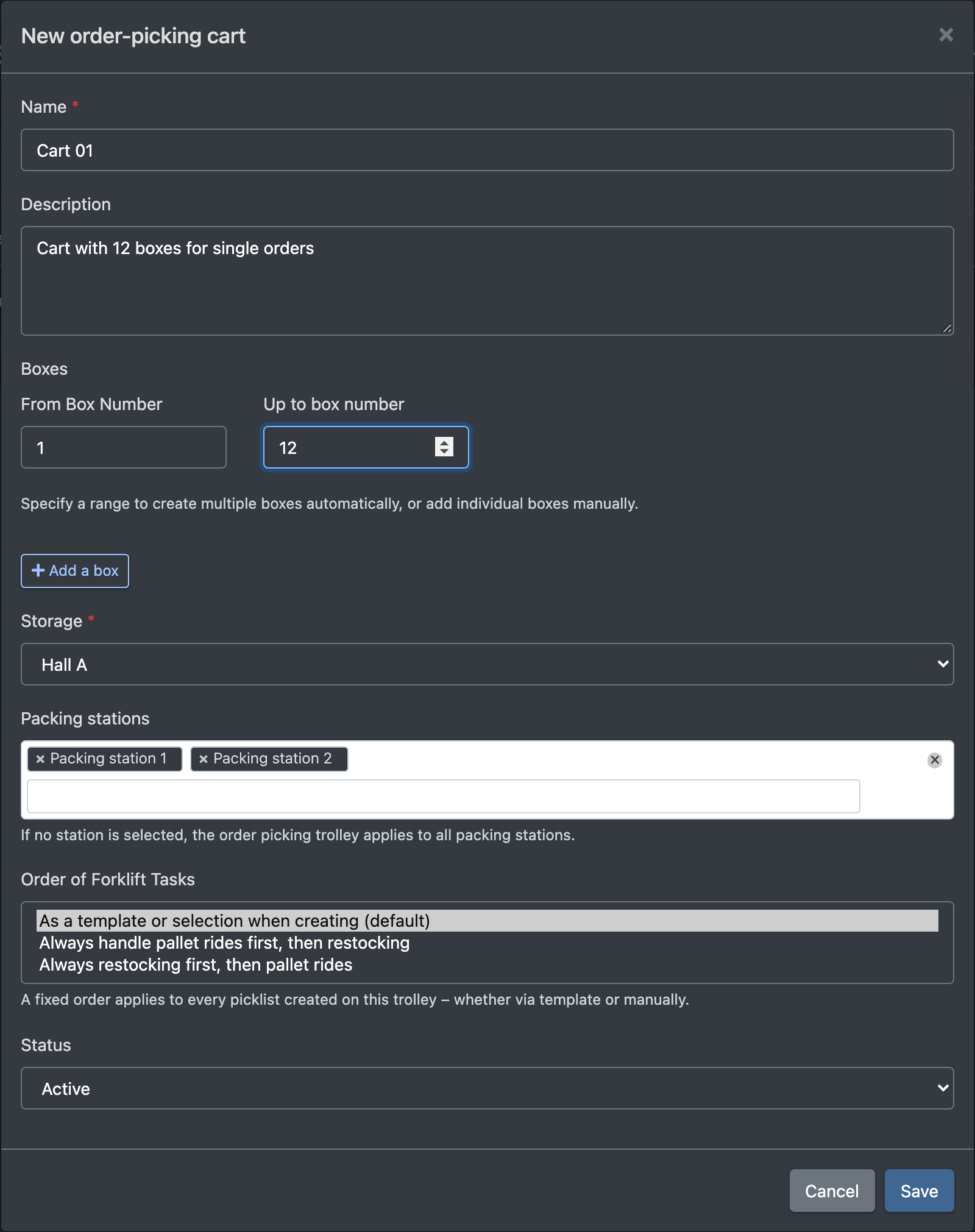
Screenshot: Form "New picking cart" with Name "Cart 01", box range 1 to 12, two packing stations selected and the forklift order drop-down

Edit and delete carts with the action buttons in the table. You can filter the list by search, status (All / Active / Inactive) and warehouse.

Fields and options

Field Meaning Required
Name (Name) Name of the cart, scanned during picking yes
Description (Beschreibung) Free text, shown when a cart is chosen no
From box number / To box number (Von Box-Nummer / Bis Box-Nummer) Creates a range of boxes (1–999999). Takes priority over individually entered boxes. one of the two
Add box (Box hinzufügen) Single box numbers one of the two
Warehouse (Lager) Warehouse the cart belongs to. A new cart is assigned to the current warehouse. yes, with several warehouses
Packing stations (Packstationen) "If no station is selected, the picking cart applies to all packing tables." no
Order of forklift tasks (Reihenfolge der Stapler-Aufgaben) As template or selection when creating (default) (Wie Vorlage bzw. Auswahl beim Erstellen (Standard)), Always pallet rides first, then restocking (Immer Palettenfahrten zuerst, dann Nachbevorratungen) or Always restocking first, then pallet rides (Immer Nachbevorratungen zuerst, dann Palettenfahrten). A fixed order applies to every picklist on this cart. no
Status (Status) Active / Inactive. Only active carts are offered during picking. yes

Statuses

Situation What it means
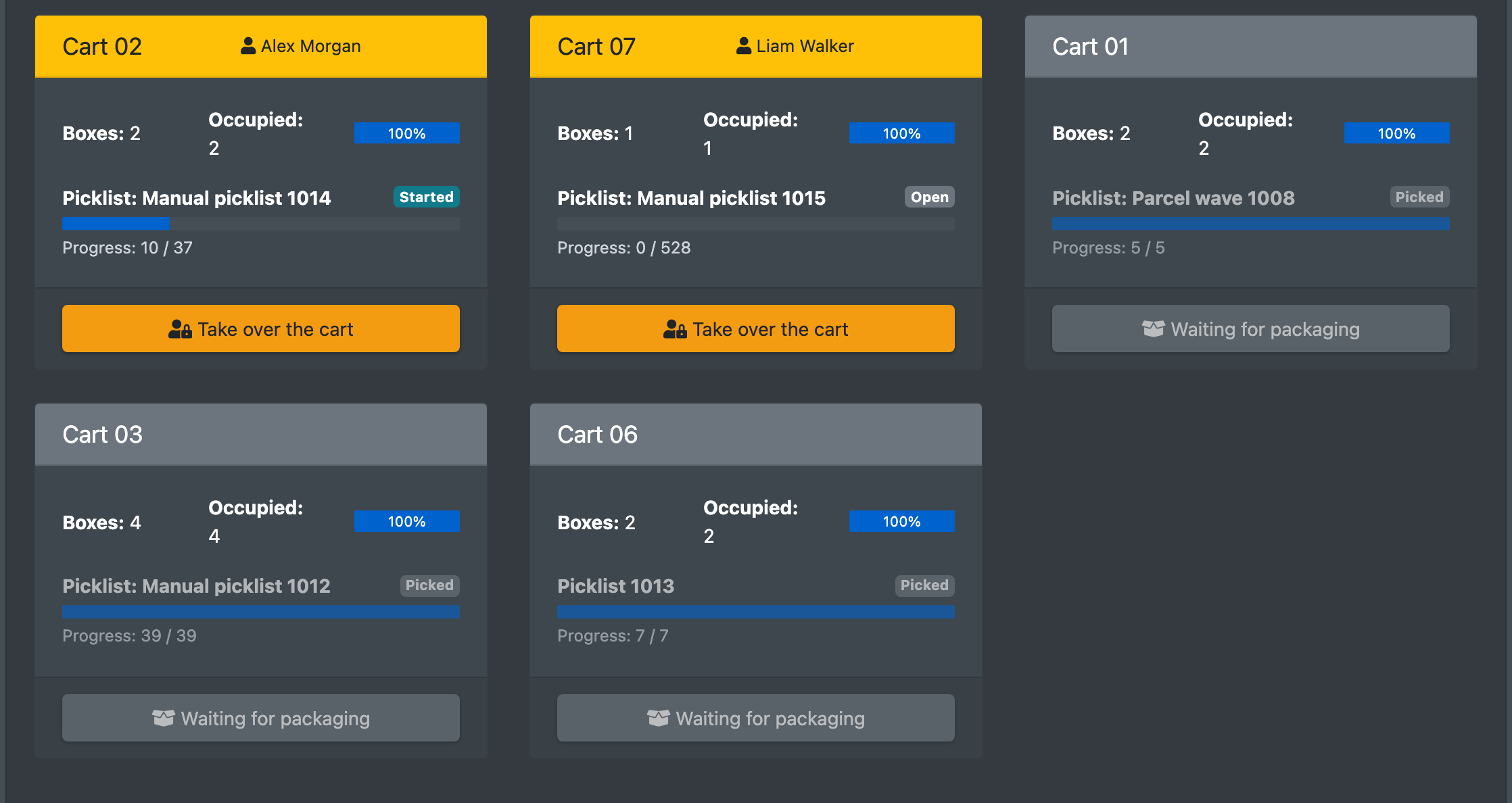
Reserved A user has reserved the cart during picking ("Reserve picking cart"). It is released with Release cart (Wagen freigeben) or automatically after the last box has been packed.
In use A picklist on the cart is open or being picked. Choosing the cart leads directly into the running picklist.
Waiting for packing The picklist on the cart is picked. The cart is greyed out and cannot be reserved until it has been packed at the packing station.
Free After the last box has been packed, the cart is free again.
Screenshot: Cart selection in the picking process with one free cart, one cart in use and one greyed-out cart waiting for packing

Where picking carts are used

  • Create a picklist – orders are assigned to the boxes of the cart.
  • Picking – the cart is reserved and worked through.
  • Packing – the box number is scanned; the system checks whether your packing station is allowed for this cart.
  • Pallet rides – order of forklift tasks.

Good to know / Troubleshooting

Message Cause Solution
The selected picking cart has no boxes defined. (Der ausgewählte Kommissionierwagen hat keine Boxen definiert.) The cart was saved without boxes. Edit the cart and add a box range or single boxes.
No available picking carts found (Keine verfügbaren Kommissionierwagen gefunden) No active cart in the selected warehouse. Create or activate a cart, check the warehouse.
This picking cart is locked for packing and cannot be reserved at the moment. (Dieser Kommissionierwagen ist für die Verpackung gesperrt …) The picklist on the cart is waiting for packing. Pack it at the packing station first – see Packing.
Picking cart is already reserved by another user (Kommissionierwagen ist bereits von einem anderen Benutzer reserviert) Another user reserved it. Choose another cart or use Take over cart (Wagen übernehmen).
The picking cart cannot be released. There is an active picklist or one waiting for packing for this cart. (Der Kommissionierwagen kann nicht freigegeben werden …) Release while a picklist is still active. Finish and pack the picklist, or delete it.
This cart is not enabled for your workstation (Dieser Wagen ist nicht für deinen Arbeitsplatz freigegeben) When packing: your packing station is not among the cart's packing stations. Add the station to the cart or use the right packing table.
Picking cart not found or no permission (Kommissionierwagen nicht gefunden oder keine Berechtigung) The cart no longer exists. Reload the page.