
Article costs

Charge handling per article, stock movement, order line, picklist line or pallet – for one article or all articles of a client.

Article costs (Artikelkosten) are the most flexible cost type. They charge services based on stock movements (e.g. putaway, transfer, goods issue), order lines, picklist lines or pallets – for one specific article or for all articles of a client. You can convert quantities into units such as cartons or pallets and restrict the charge with conditions.

Typical uses: a handling fee per item put away, a pick fee per order line, a fee per carton picked, or a fee per pallet shipped.
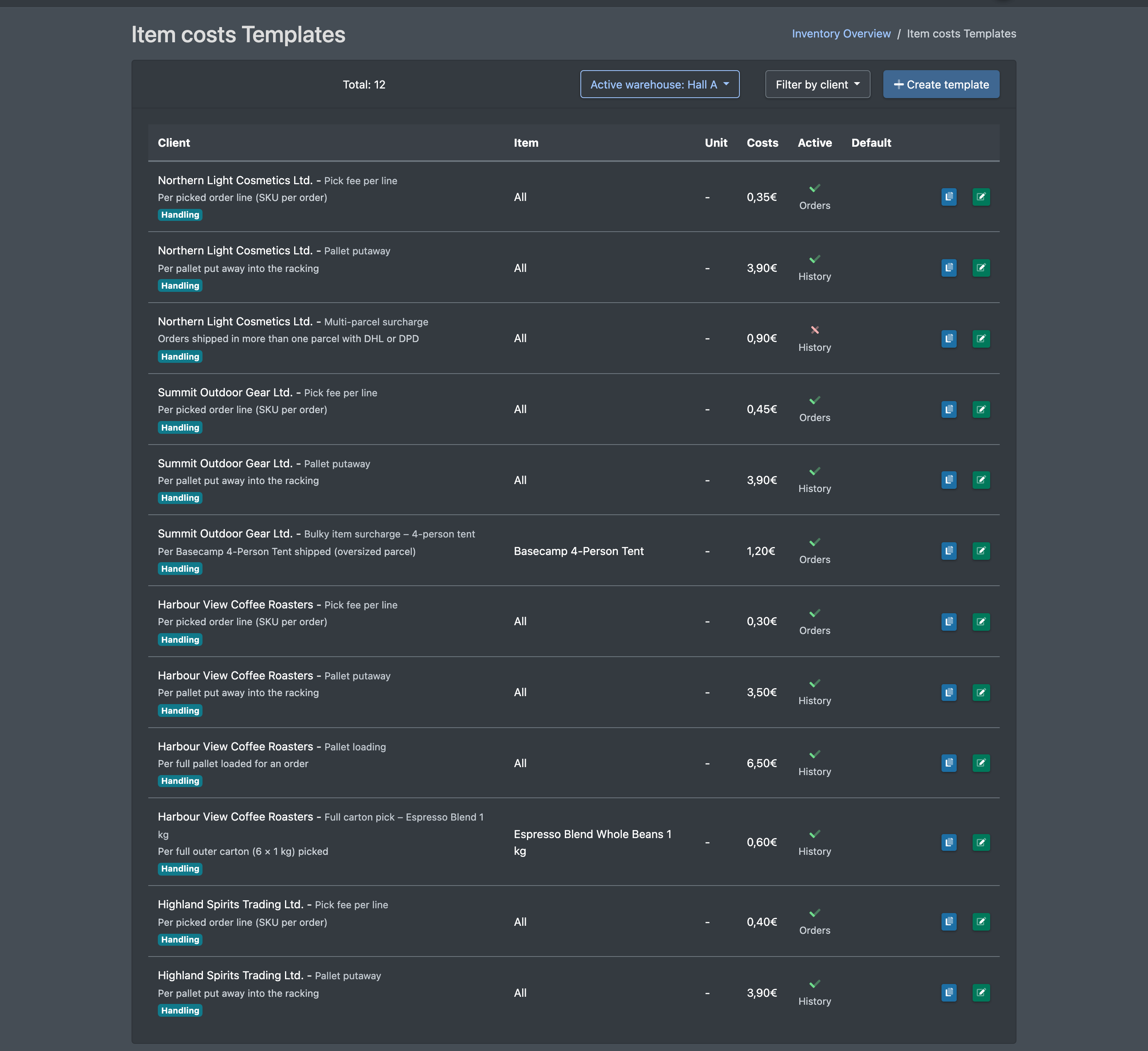
Screenshot: Item cost templates list with client filter, columns Client, Item, Unit, Costs and Active

Before you start

  • Your user needs the permissions for the article costs in the cost settings – ask your administrator.
  • The client exists, see Clients.
  • A Billing Category is required, see Service categories.
  • The stock movement reasons you want to charge (the Action) are maintained in the warehouse settings in the field Stock movement / reason (Lagerbewegung / Grund), see Warehouse settings. The form contains a direct link to this field.
  • The quantity units and loading units (e.g. carton, pallet) are maintained in the Warehouse settings.
  • For Dynamic picks: the articles have the attribute "units per box" maintained, see Edit an article.

Step by step

  1. Open WMS › Settings › Cost settings › Item costs (WMS › Einstellungen › Kosteneinstellungen › Artikelkosten).
  2. Click Create template (Vorlage anlegen).
  3. Section Base information (Basisdaten): choose the Client (Mandant) and optionally a Module (Modul), enter a Name (Name) and optionally a Custom Name (Individueller Name). Choose the Billing Category (Abrechnungs-Kategorie) and the Itemized statement on the invoice (Detail-Darstellung auf Rechnung), tick Active (Aktiv). Optionally enter a Detailed description (Detailbeschreibung) – it appears line by line on the invoice.
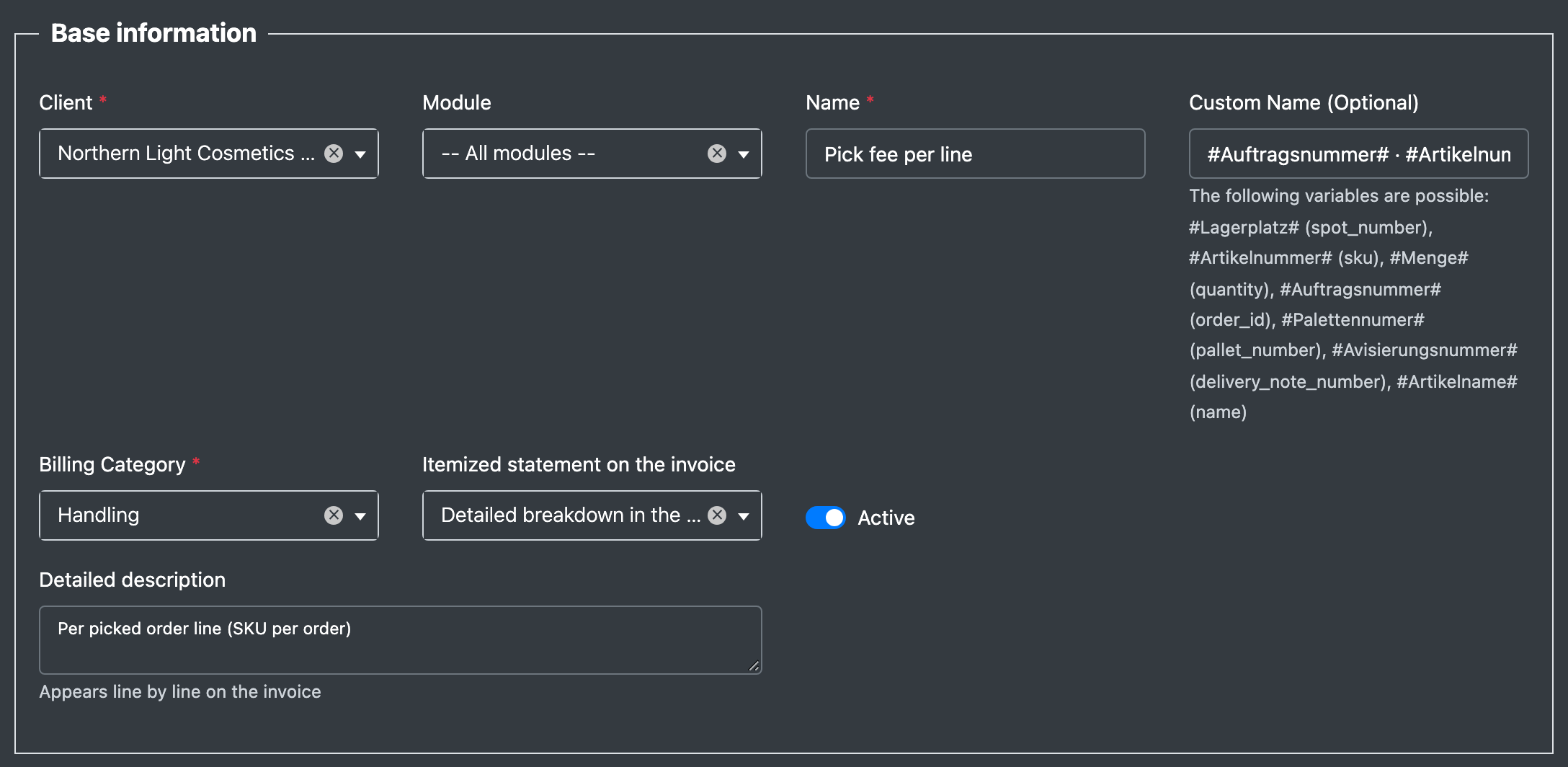
Screenshot: Section "Base information" of the item cost template form
  1. Section Item & Quantity (Artikel & Menge): choose the Stock item (Lager Artikel) or All (Alle), the Items to be calculated (Zu berechnende Positionen), Calculate from (Ermitteln aus), optionally a shipping status (Versandstatus), the Action (Aktion) and the actions to exclude (Aktionen ausschließen). Then define the Quantity (Menge) with unit, operator and number.
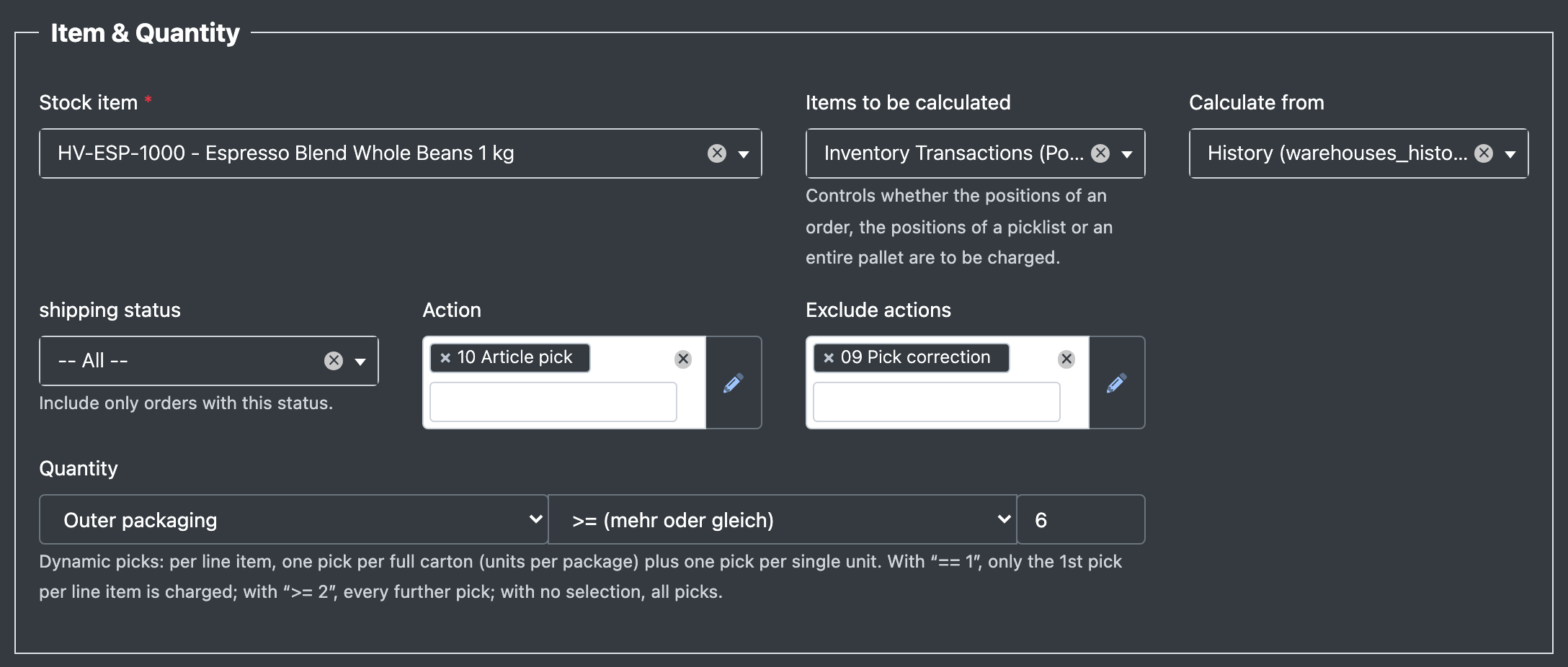
Screenshot: Section "Item & Quantity" with Stock item, Items to be calculated, Calculate from, Action and the Quantity row (unit, operator, number)
  1. Section Costs & Terms (Kosten & Bedingungen): enter the Costs (Kosten) and optionally add conditions under Conditions / Triggers (Optional) (Bedingungen / Auslöser).
  2. Optionally set a validity period and click Save (Speichern).
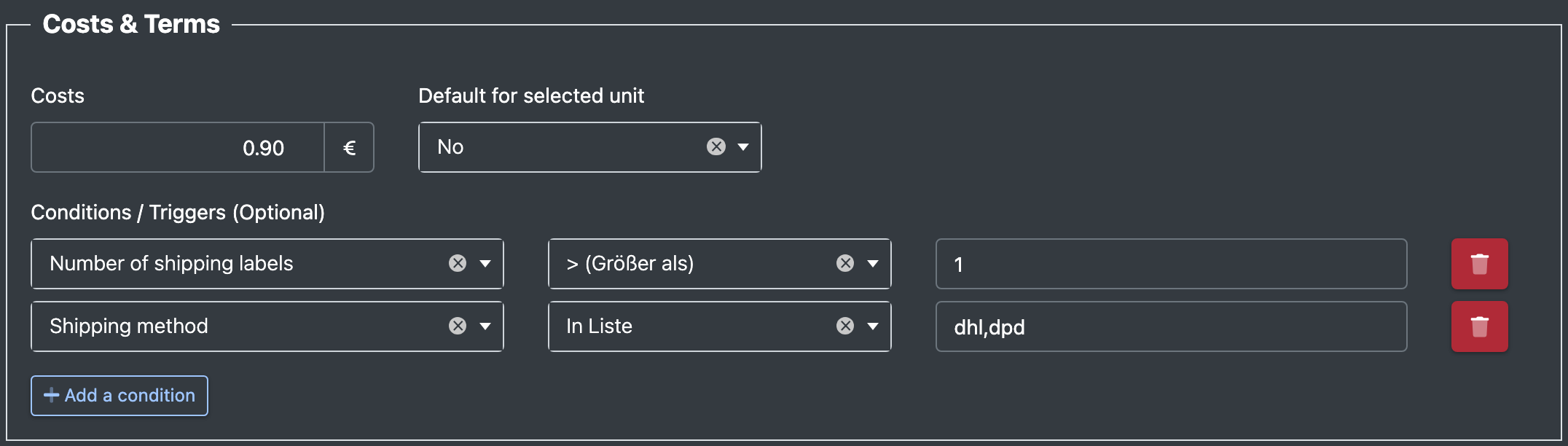
Screenshot: Section "Costs & Terms" with Costs and two conditions (Number of shipping labels, Shipping method)

Fields and options

Field Meaning Required
Client (Mandant) The client you are billing. yes
Module (Modul) Only orders from this sales channel are charged. Empty = all modules. no
Name (Name) Name of the item on the statement. yes
Custom Name (Optional) (Individueller Name) Text per line in the detailed breakdown. You can use the variables #Lagerplatz# (storage place), #Artikelnummer# (SKU), #Menge# (quantity), #Auftragsnummer# (order number), #Palettennumer# (pallet number), #Avisierungsnummer# (advance notice number) and #Artikelname# (article name). no
Billing Category (Abrechnungs-Kategorie) Groups the item on the statement. yes
Detailed description (Detailbeschreibung) Appears line by line on the invoice. no
Stock item (Lager Artikel) One article (search by SKU or name) or All. yes
Items to be calculated (Zu berechnende Positionen) What is charged: Order line (total) (Auftragsposition (summieren)) = the piece quantity of the order lines; Order items (count) (Auftragspositionen (zählen)) = the number of order lines; Picking list items (Picklistenpositionen); Pallet (Palette) = each whole pallet once; Stock movements (booked quantity according to history) (Lagerbewegungen (gebuchte Menge laut Historie)). no
Calculate from (Ermitteln aus) History = the stock movements of the client; Orders = the orders and their lines (date = delivery date). no
shipping status (Versandstatus) Only orders with this status are charged. no
Action (Aktion) The stock movement reasons that are charged (multiple selection). no
Exclude actions (Aktionen ausschließen) Orders with one of these movements are not charged. no
Quantity – unit (Menge) A quantity or loading unit (e.g. carton, pallet), Fixed value (Statischer Wert / Fixwert) = a fixed number per hit, or Dynamic picks (including units per box / carton) (Dynamische Picks). no
Quantity – operator See the table below. no
Costs (Kosten) Price per calculated unit. yes
Conditions / Triggers (Optional) (Bedingungen / Auslöser) Number of positions (Anzahl der Positionen), Number of shipping labels (Anzahl Versandlabel), Position Type (Positions-Typ, article or carton), Item SKU (Artikel-SKU), Is a pallet (Ist Palette), Shipping method (Versandart) – each with operator and Value (Wert). no
Active (Aktiv) Only active templates are charged. –

Quantity operators

Operator Effect
empty The quantity is used 1:1.
>= (mehr oder gleich) Quantity ÷ number, rounded down – e.g. full cartons.
== (gleich) Quantity ÷ number, rounded up – e.g. started cartons.
<= (weniger oder gleich) 1 if the quantity is less than or equal to the number, otherwise 0.

Dynamic picks: per line, one pick is counted per full carton (units per box) plus one pick per single piece. With == 1 only the first pick per line is charged, with >= 2 every further pick, without an operator all picks.

How the charge is calculated

Depending on your settings, the statement uses one of these sources:

  • Stock movements (history): the client's movements with the selected reasons in the billing period, grouped per order, article, day and reason. With Pallet, each pallet outbound movement counts once.
  • Orders: orders and their lines with a delivery date in the billing period.
  • Order lines (goods issue / packing): the lines from packing; "total" = piece quantity, "count" = number of lines.
  • Picking list items: picked lines with the status picked, packed or shipped.

The Module filter excludes orders from other sales channels.
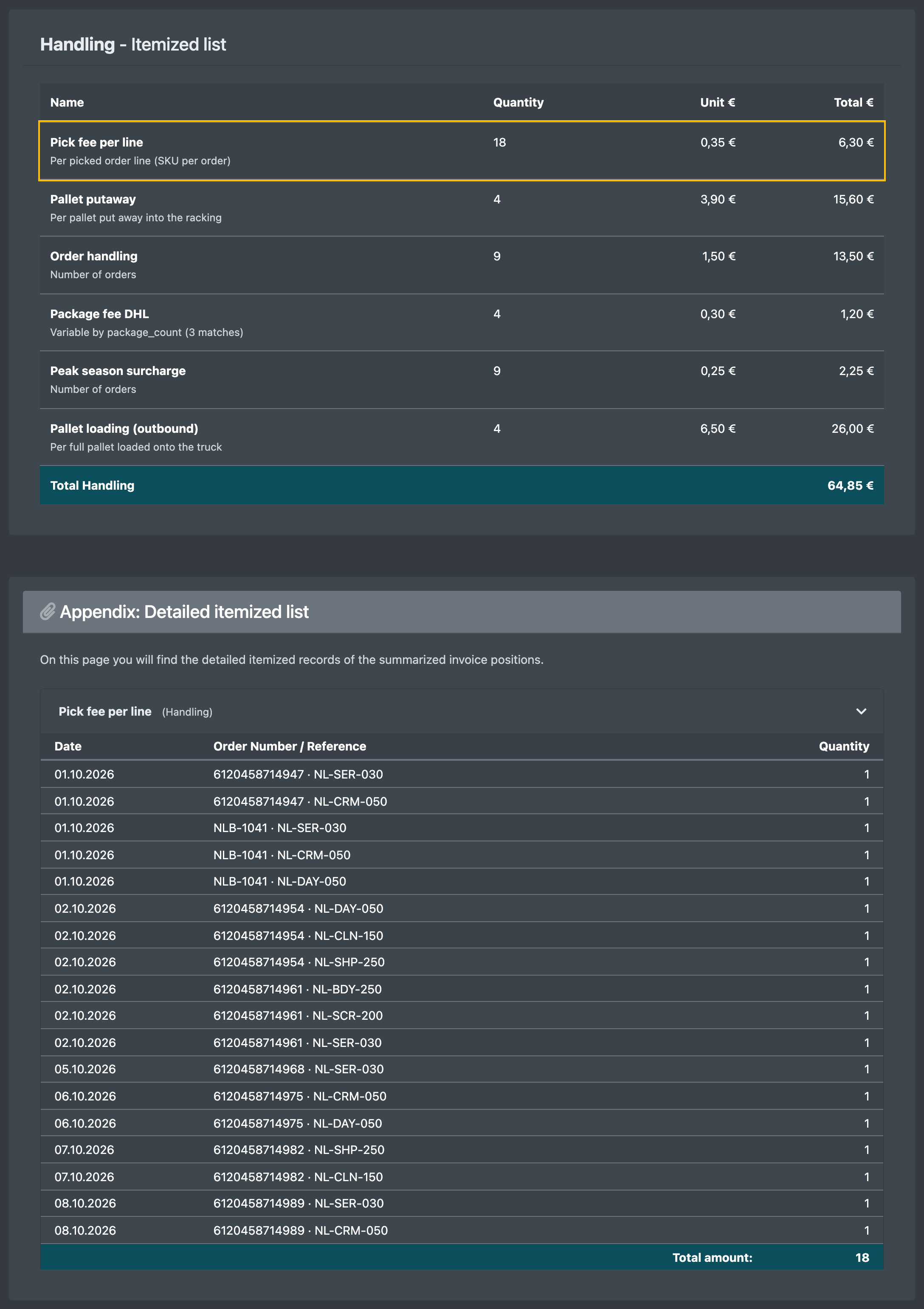
Screenshot: Client statement with an article cost item "Pick fee per line" and its detailed breakdown with order numbers

Good to know / Troubleshooting

Message Cause Solution
The entry has been saved / updated / removed The action was successful. –
Quantities are counted twice or are missing The combination of Items to be calculated and Calculate from does not fit, or the operator is wrong. Check the settings and test with a short billing period in Client billing.
The template is gone When an article is deleted, its article cost templates are deleted too. Create the template again or use All.
  • Use Duplicate (Duplizieren) in the list to create similar templates quickly. The copy is inactive until you activate it.